The Nation of Israel has an interesting governmental system which draws many similarities to that of the United States’. There is one President, or Prime Minister, who serves as the Chief of Parliament, or The Knesset, as it is referred to in Israel. The President may serve a maximum of two terms in office, with each term lasting no more than five years. There is no Vice Presidential position, and therefore, it is the duty of those in The Knesset to fulfill the Prime Minister’s respective roles when he or she is unable to do so. Much like the President of the United States, Israel’s Prime Minister is in charge of appointing judges, selecting cabinet members, and appointing ambassadors as well as other diplomatic representatives. The Knesset is a division of political members who consult with one another as well as the Prime Minister when discussing political treaties, foreign affairs, and newly proposed laws. While Israel’s government resembles a Democracy, there are laws in this nation which tend to pose a bias in favor of the Jewish citizens- and thus separate this nation from being purely democratic. An example of this is Israel’s “Law of Return” which “provides automatic Israeli citizenship for Jewish immigrants, whereas Palestinian refugees who were born and raised in what is now Israel are denied even the right to return home” (http://www.jerusalemites.org/articles/english/2007/febraury/151.htm).
Today, Israel’s government is classified as a parliamentary democracy consisting of the same three governmental branches as those in the United States: the Legislative branch, the Executive Branch, and the Judicial Branch. At the helm of this government is President Shimon Peres, Israel’s ninth president since their establishment in 1948. As of recently, President Peres has shifted Israel’s focus towards military and defense, as they have consistently faced threats from the surrounding nations, specifically Iran. Although this country has a Parliamentary Democracy, it has no constitution, but rather, has acquired a majority of the English and British common laws for its legal system.
While Israel’s political and foreign affairs have continuously wavered since its establishment, its economy has remained strong throughout the majority of its existence as a nation. As of 2008, Israel’s gross domestic product was more than 100 billion dollars in total, while its unemployment rate was relatively low, at 10%. It relies heavily on the exportation of products such as diamonds, textiles, machinery, and software for its income, while relying on its own agricultural production to suffice 75% of its domestic needs (http://looklex.com/e.o/israel_2.htm). Israel’s economy is well-known for its advancements in technology, which make it a primary exporter of such goods as computers and weapon technology. Primarily, these exports reach the shores of the United States, Belgium, and Hong Kong. Its imports consist of oil, military equipment, grain, and raw materials, which are primarily received from countries such as the United States, Belgium, China, Germany, Switzerland, and a few others. (https://www.cia.gov/library/publications/the-world-factbook/geos/is.html). For the past six years, up until the year 2008, this countries economy had continued to expand at a rate of more than 5% annually, giving it one of the most diversified and successful economies in the Middle Eastern region. Recently however, it has experienced economical downfalls much like the rest of the world, with its GDP rate falling from $185 billion in the year 2007 to a little more than $105 billion in the year 2008 (http://looklex.com/e.o/israel_2.htm). The Israeli “shekel” is the type of currency used, as about four shekels are equal to one American dollar. With most of the Israeli tax dollars going towards maintaining the defense system, Israeli economists are expecting more of the Israel shekels to revive the Israeli economy in the following months, as military spending continues to decline.
Citations for Economy, Government, and Historical Information:
Qumsiyeh, Mazin. “Is Israel a Democracy?” Jerusalemites. 15 February, 2007. http://www.jerusalemites.org/articles/english/2007/febraury/151.htm).
C.I.A. “Israel.” Central Intelligence Agency: World Factbook. 18 December, 2008. https://www.cia.gov/library/publications/the-world-factbook/geos/is.html
Coutsoukis, Photius. “Israel the President.” Israel Government. 10 November, 2004. http://www.photius.com/countries/israel/government/israel_government_the_president.html
Kjeilen, Tore. “Israel/Economy.” Looklex Encyclopaedia. 1996-2008. http://looklex.com/e.o/israel_2.htm
Science.co “Brief History of Israel and the Jewish People.” Israel History and Technology Homepage. 1999-2008. http://www.science.co.il/Israel-history.asp
Friday, December 26, 2008

Thursday, December 25, 2008


Wednesday, December 24, 2008
History of Israel
While the state of Israel was formally established on May 14th, 1948, the history of its nation and its people can be dated back thousands of years before the birth of Christ. The Israelites were travelers, nomads so to speak, and were rarely established in one region or another up until the mid 20th century. The history of the Israelites, also known as the Jewish people, is extensive, dating back almost 4,000 years ago. Abraham, referred to as the founding father of the Jewish people, was believed to have been a prophet called upon by God some 1,800 years before the arrival of Jesus Christ. He was to share the knowledge to the Israelites that there was but one God, and that they were to pray to and honor this God unconditionally. This epiphany, gave way to the belief in monotheism among the Jewish people, which consequently separated them from the majority of other cultures and religions at that time. After accepting this monotheistic view, the Jewish people were looked down upon throughout the Middle-Eastern, Asian, and European regions of the world (which were predominately polytheistic). They were tortured, ridiculed, and eventually enslaved- most notoriously by the Egyptians. For hundreds of years, the Jewish people worked under the supervision of the Egyptian Pharaohs, until they were eventually freed by Moses, another prophet called upon by God to deliver his people from the land of Egypt. It is believed that this deliverance occurred around 1300 years before the birth of Christ, which then gave way to the wandering of the Jewish people for 40 years throughout the Middle-Eastern deserts until they eventually stumbled upon the land now known as the Land of Israel- which was promised to the Jewish people by God. The prophet Moses was also responsible for introducing the Jewish people to the Ten Commandments as well as the Torah (which in the Christian Religion is the Old Testament of the Bible). Both the Torah and the Ten Commandments remain vital parts of Jewish law in today’s society, as well as the basis of the Jewish religion, Judaism.
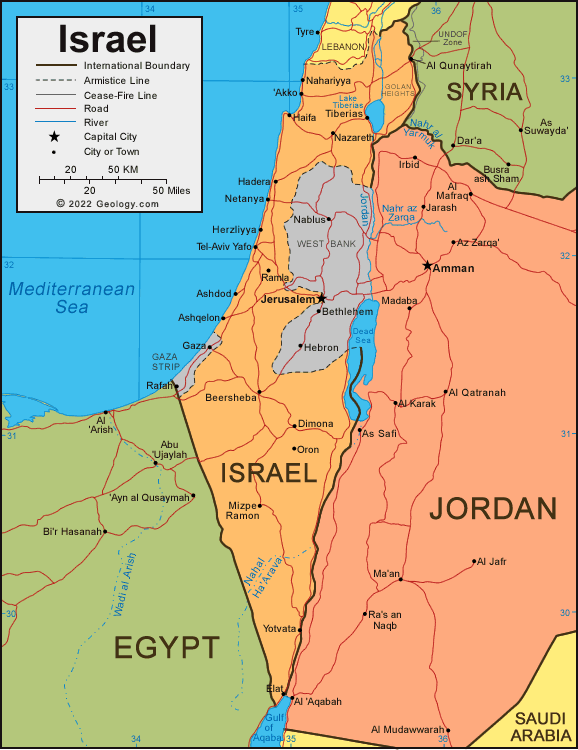
From the year 1000 B.C. to around 580 B.C., Israel was a successful nation ruled by many kings. Its capital of Jerusalem had been established under the reign of King David, while the first Jewish temple was built by David’s son and predecessor, King Solomon. The Nation of Israel seemed to have finally found stability, until Nebuchadnezzar’s Babylonian army arrived in 587 B.C., destroyed the Jewish temples, and ultimately captured Israel’s capital, Jerusalem. This marked the end of Israel’s stability for the next 2,500 years. The Babylonians lost this region to the Persians, the Persians lost this region to the armies of Alexander the Great, Alexander lost this region to the Romans, the Romans to the Byzantines, the Byzantines to the Arabs, Arabs to the Crusaders, the Crusaders to Mamluks, the Mamluks to the Ottomans, and finally, the Ottomans to the British Empire, which brings us to the year 1917. Up until this time, the Jews were again enslaved, tortured, ousted from the Middle-Eastern region, and ridiculed by the majority of their enemies. Their temples were destroyed, and Mosques, Palaces, and Castles were built in their place. Finally, on May 14th, 1948, the British Empire decided a homeland was owed to the people of Israel. After wandering aimlessly under oppression for thousands of years, the Jewish people were allotted the Land of Israel inside the Palestinian nation, which has now been divided into two nations- Jordan and Israel.
From the year 1000 B.C. to around 580 B.C., Israel was a successful nation ruled by many kings. Its capital of Jerusalem had been established under the reign of King David, while the first Jewish temple was built by David’s son and predecessor, King Solomon. The Nation of Israel seemed to have finally found stability, until Nebuchadnezzar’s Babylonian army arrived in 587 B.C., destroyed the Jewish temples, and ultimately captured Israel’s capital, Jerusalem. This marked the end of Israel’s stability for the next 2,500 years. The Babylonians lost this region to the Persians, the Persians lost this region to the armies of Alexander the Great, Alexander lost this region to the Romans, the Romans to the Byzantines, the Byzantines to the Arabs, Arabs to the Crusaders, the Crusaders to Mamluks, the Mamluks to the Ottomans, and finally, the Ottomans to the British Empire, which brings us to the year 1917. Up until this time, the Jews were again enslaved, tortured, ousted from the Middle-Eastern region, and ridiculed by the majority of their enemies. Their temples were destroyed, and Mosques, Palaces, and Castles were built in their place. Finally, on May 14th, 1948, the British Empire decided a homeland was owed to the people of Israel. After wandering aimlessly under oppression for thousands of years, the Jewish people were allotted the Land of Israel inside the Palestinian nation, which has now been divided into two nations- Jordan and Israel.
Subscribe to:
Comments (Atom)