Current Conflict: Israeli Forces Battle Hamas Terrorist Organization in Gaza Strip
Background: As we look at the history of the Gaza Strip, we find an area of land plagued by political conflict and war. The Gaza Strip is located on the border of Israel and Egypt and currently serves as home to both Arabs and Jews. Initially, the Gaza Strip was under Egyptian rule from 1948-1967, until it was lost to the Israelites during the Six Day War in 1967. From 1967 until 2005 Israel governed the Gaza Strip, but agreed to allocate this area of land to the Palestinian people- a nomadic group which had struggled to find a homeland among the Middle Eastern regions. Today, Israel still controls the airstrips and waterways in and around Gaza, as they also provide food, fuel, and electricity to the region. As of 2005, however, a terrorist group known as Hamas, originally founded in 1987, has taken control of much of the Gaza Strip, inflicting terrorist acts against not only Israelites, but Palestinians as well. Hamas is responsible for firing missiles into Israel, carrying out suicide bombing missions along the Gaza-Israel border, and intimidating political leaders in Gaza as of late. They have been classified by the United States, Canada, the European Union, Japan, Israel, and Jordan as a terrorist group, and have been condemned for their actions against the Israeli people. The Israelites claim that not only are members of the Hamas responsible for terrorist attacks, they are also to blame for the hording of food and natural resources in which Israel sends to the Palestinian and Jewish people in the Gaza Strip. Hamas claims that their mission is to liberate the Palestinian people from Israeli dependence, so that the Palestinians may have their own independent nation. While Israel and Hamas have wavered back and forth on peace treaties, the violence erupted once again on November 5th, 2008, when members of Hamas fired a dozen missiles into Israel. While the missile attacks did not kill any Israeli people, Israel responded by killing seven Palestinians they deemed responsible for the attacks. This counter attack has given way to an ongoing battle between the Hamas terrorist organization and the Israeli military, which has continued into January of 2009. Currently, Israel has sent fighter planes into Gaza as well as ground support. The results have been devastating as Israeli air strikes have claimed the lives of both Hamas fighters and Palestinian civilians. Israel, however, vows to continue their strikes for weeks or until the Hamas terrorist organization has been completely eliminated from the Gaza Strip.
Haaretz Daily Newspaper (Israel): To Win, All Israel Has to do is Survive. – Writer Brad Burston. (http://www.haaretz.com/hasen/spages/1050962.html)
Writer Brad Burston’s article, “To Win, All Israel Has to do is Survive”, sheds light on recently-deceased Hamas leader and Islamic University professor, Nizar Ghayan, and his confidence in the Hamas terrorist organization. Ghayan, believed to be one of the top-five leaders of Hamas, was killed in an Israeli air strike last Thursday, when he refused to surrender himself to Israeli forces in the Gaza Strip. Surrounded by his four wives and eleven children, Nizar Ghayan remained in hiding within his Gaza apartment complex, and was consequently killed when the building was obliterated by missile attacks. Burston’s article points out that Nizar Ghayan frequently preached to his students about the power of martyrdom, and how an Israeli attack against Hamas fighters would only lead to such. Ghayan believed that the Hamas terrorist organization would be considered victorious as long as they simply “survived” the Israeli attacks. If Hamas could survive the Israeli attacks, they could continue preaching against the Jews, recruiting more members for their militia, and grow in power until they could eventually liberate the Palestinian people from Israeli rule. Writer Brad Burston, however, focuses on Ghayan’s maxim, as well as his death, to demonstrate a turning point in the Israeli military’s attitude. He notes that during the Second War of Lebanon in 2006, Hamas leaders such as Nizar Ghayan would make military bases inside of Mosques and would surround themselves with their wives and children knowing the Israeli military would not attack them to the political backlash they would receive for carrying out such attack. As we fast-forward three years to the current situation in the Gaza Strip however, we see the body of a deceased leader, Nizar Ghayan, who inevitably tested the patience of the Israeli military. Two Mosques, which were housing Hamas fighters and their weapons, were destroyed 24 hours after Ghayan’s death- leaving many Hamas fighters panicked and without refuge. While Burston does not support the destruction of Muslim Mosques in his article, he does note that this sort of attack is long overdue. He mentions how even the Palestinian people have become tired of the Hamas organization- which seems to be behind the instigation of many of the Israeli military attacks. Burston points out that this Islamic Extremism in the Gaza Strip has lead to the destruction of more Palestinian lives than it has Jewish lives, and finally the Palestinians have had enough of the bloodshed. The Hamas terrorist organization tries to label itself as the liberators of the Palestinian nation, yet the Palestinian people as well as allies of Hamas such as Hezbollah and Syria, refuse to help them fight against the Israelis. I would have to agree with most of the points Burston makes, because he speaks on behalf of both the Israelites and the Palestinians. He does not believe that either ethnicity of people should fall victim to the ignorance of a single terrorist organization. While the Israeli army attacks the Gaza Strip with missiles it is easy to blame them for the deaths of so many civilians, yet we must remember that they do it in defense of their own nation. Burston’s article makes an important point that in order to once and for all- rid the Gaza Strip of the Hamas existence an all-out military onslaught against terrorism must take place.
CNN.com/world: “Israeli strike kills at least 1 aid worker, U.N. says” – Writer CNN http://www.cnn.com/2009/WORLD/meast/01/08/israel.gaza/index.html
CNN’s report on the Israeli occupation in the Gaza Strip provided a much different perspective than the report published in Israeli writer Brad Burston’s, article. Today, January 8th, 2008 (American standard time), Israeli forces were seen firing on a U.N. Aid convoy which was headed into the Gaza Strip to deliver much needed resources. In result, the driver of the vehicle was killed immediately, and therefore was unable to deliver any of the supplies to the Palestinian people. As CNN reported, this attack took place during a 3 hour cease-fire period which the Israeli military allocated so that humanitarian aid could be distributed to the victims of the ongoing battle. The UNRWA director, John Ging, openly expressed his agitation with the Israeli military noting that they had cleared the way for humanitarian service, and then unleashed fire on the convoy as it began to enter the Gaza Strip. Ging noted that in the past two weeks, four U.N. workers have been killed because of the Israeli air strikes, and should the erratic Israeli military-style continue, he would have to place a hold on the U.N.’s humanitarian aid- which consequently serves more than a million people living in the Gaza Strip. Ging also brought to CNN’s attention that the conditions in the Gaza Strip are absolutely horrific, however the Israeli government refuses to allow journalists inside the Strip and therefore the world is oblivious to the atrocities taking place. Palestinian authorities reported later that more than 760 Palestinians have died in Gaza because of the attacks, with 40% of those dead being either women or children. The Israeli’s however have lost just nine soldiers in the fighting thus far, including two who were killed earlier today. The Israeli army remains adamant that the fighting will continue until the Hamas organization has been disabled from shooting their rockets into Israeli territory. Meanwhile, Israel disputed the lack of humanitarian aid as they estimated 50 humanitarian trucks had entered into the Gaza Strip on Thursday. As I read this article, I definitely notice a difference between its depiction of the Israeli-Hamas fighting and Israeli writer Brad Burston’s perspective. Burston’s article justifies the intense military attacks by the Israeli forces, arguing that the Hamas fighters have for too long been allowed to harm the Israeli people and cause disruption among the Gaza Strip. CNN’s perspective focuses much more on the victims of the current attacks- the Palestinian people. 765 people have fallen victim to these attacks in the past two and a half months, and many of the victims have been unarmed women and children. While Israel should have every right to defend their homeland- a stance taken by Brad Burston- I believe they should do so in a manner that is far less erratic. By flying over the Gaza Strip and dropping missiles into houses and other buildings, they increase their chances of killing innocent human beings. I do believe some sort of action should be taken by the Israeli government in order to protect their people, but the Hamas terrorist group is only a terrorist group, so to use full-force military operations against a relatively small group of insurgents seems a bit extreme, and the casualties demonstrate just that. This article by CNN definitely takes a step back and paints a full picture of the events taking place in the Middle East. CNN does not approve of the Hamas attacks, but rather prefers Israel finds a more peaceful way to resolve the situation at hand.
Foxnews.com: “Son of Hamas Leader Gives Glimpse Into Terror Organization”.- Writer Fox News: http://www.foxnews.com/story/0,2933,475226,00.html
Foxnews’ January 3rd, 2009 article took a look at the inside of the Hamas Terror Organization through the eyes of a former member, Mosab Hassan Yousef- the son of Sheikh Hassan Yousef- who helped found the organization in 1987. While the ongoing battle between Israeli forces and Hamas fighters continues to wage, Fox News reporters wanted to take a look at the organization from the standpoint of someone who had at one time been a close part of it. Mosab Yousef was a member of the Hamas Terror Organization for as long as he could remember. He was raised under the Hamas beliefs that using violence against Israeli authority was completely acceptable. The article notes that as he grew older, he ascended the ranks of the organization, and eventually reached the level of leader of the Radical Islamic Youth Movement, which was constantly involved in fighting with Israeli troops, army tanks, and suicide bombing missions. Yousef mentioned that the organization thrived off of the recruitment of young men, as they were immediately transformed into Hamas fighters. He added that this militant group was known to even “torture its own members” and that it goes against even the Palestinian beliefs of morality- the very people this organization vows it is protecting. This article provided incredible insight to the current situation taking place in the Gaza Strip because it allows us to put a face to the terrorist groups that continue to hide behind masks, M-16’s, and RPG’s. Mosab Yousef, who has now converted to Christianity, was even quoted in this article as saying, “Islam is not the word of God. If you want to be offended that is your problem. But you know something? Go study. Think for a second that I may be right. So wake up, look at your path, see where you’re going. Are you really going to heaven with 72 virgins after you kill yourself and kill another 20 people?” Fox News reports Yousef placing the blame on his father and his organization. He claims that his father and his followers believed they were fighting against the Israeli people for the cause of liberating the Palestinian people, but while they pursued this cause, they maimed and killed thousands of innocent Palestinians. I think Fox News’ interview with Mosab Yousef might have been the most important and unbiased report offered in the three articles I have read. Mosab was a member of the Terror Organization which opposes Israeli rule, and while he has not completely switched sides, he offers insight into how reckless and insensitive the Hamas Terror Organization has been. Mosab also denounces the Muslim faith in the interview, and though he does this to make his point against terrorism and extremism, I feel this comment was somewhat irrelevant to the rest of the interview. While this article does not focus directly on the current conflict occurring at this moment in the Gaza Strip, it provides excellent insight into the way in which the Hamas Terror Organization thinks, and thus we have a better understanding of why this current conflict is taking place. In comparison to the first two articles, I feel Fox News article offers a perspective of the Hamas fighters as opposed to the Israeli perspective observable above. Hamas see themselves as liberators of the Palestinian people, and while their methods are inexcusable, we can at least understand why they are going to such great lengths separate from the Israeli rule- even if we completely disagree with their cause.
My Resolution:
As I look at the situation taking place in the Middle East, and the ongoing conflict that restlessly occurs along the Gaza Strip, I cannot help but feel sorrow for the Palestinian people. As Israeli air strikes continue to pound down upon the various regions of the Strip, hundreds of Palestinian civilians have been caught between the crosshairs. I will not, however, place the blame on the Israeli people. They have been every bit as harassed by the Hamas Terror Organization, as missiles continue to fly from the Gaza Strip, into homes, shopping malls, and restaurants located in Israel. While I believe the fairest way to resolve this problem would be to allocate the Gaza Strip as the homeland for the Palestinian people, doing such would no doubt result in the same uprising of terrorist organizations as we see currently in this region of the world. Instead, I believe the Gaza Strip should be split into two pieces, with the northern half belonging to Israeli rule, and the southern half belonging to Egyptian rule. The Gaza Strip is to be split in half from Kefar Darom. Kefar Darom, a predominately Muslim city, as well as those in the southern regions of the Gaza Strip will be given to Egypt, and the rest of the cities north of Kefar Darom will be given to Israel. While this plan does not precisely outline a new homeland for the Palestinian people, it does relieve the Israelites from the responsibility of doing so. I do not believe a Jewish state can whole-heartedly allocate some of their land for the creation of a Muslim state, as it goes against their politics and religion. However, if Egypt- a predominately Muslim state- chooses to take their half of the Gaza Strip and establish it as the homeland for Palestinians, then so be it. This eliminates the conflict over land. Both sides have an equal share of land, and if the Palestinians continue to ask for their own homeland, they will be dealing with a Muslim nation (Egypt) which shares common ideals and beliefs, as opposed to the Jewish nation of Israel- which has a much different agenda. Also, should terrorist activity arise once again amongst the Gaza Strip, it will now be a responsibility of the Egyptian government as well- which would undoubtedly be more persuasive when dealing with Islamic extremists than a Jewish government would.
Thursday, January 8, 2009

Saturday, January 3, 2009



References
The American Israel Cooperative Enterprise. “Virtual Israel Experience”. 2008. http://www.jewishvirtuallibrary.org/jsource/vie/Telaviv.html
Weill-Rochant, Catherine. “Tel Aviv Guide”. August 2008.
http://www.telavivguide.net/Tel_Aviv_Overview/History_and_Culture/The_History_of_Tel_Aviv_2005091333/
Weill-Rochant, Catherine. “Tel Aviv Guide”. August 2008.
http://www.telavivguide.net/Tel_Aviv_Overview/History_and_Culture/The_History_of_Tel_Aviv_2005091333/
Friday, January 2, 2009
The City of Tel-Aviv
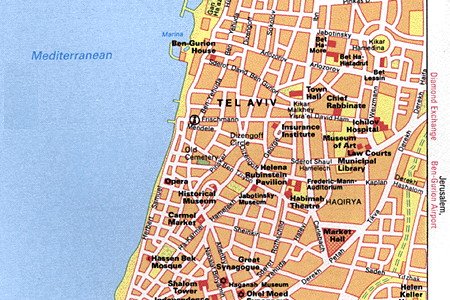
Tel-Aviv, currently the capital of Israel, was founded in 1909 by David ben Gurion and sixty other Jewish families, 39 years prior to the official establishment of Israel as a nation. It is located very closely to the ancient city of Jaffa, which is known religiously as the home of the prophet Jonah. Jaffa was considered the melting pot of Israel at this time in history for it homed a vast array of ethnic cultures from the Arabs to the Jews. Eventually however, the city of Jaffa became extremely overpopulated during the early 20th century, and a large amount of Jews, led by David ben Gurion, decided to leave the ancient city, in which they ultimately settled upon the neighboring region of Tel-Aviv or, The Hill of Spring. The name Tel-Aviv is derivative from two Hebrew words; "Tel" meaning a hill covering an ancient settlement, and "Aviv", meaning Spring. Its name is symbolic, as it serves as the connection between the old and the new ways of life for the Jewish people. Sadly, in 1917, just 8 years after the city's foundation, its Jewish citizens were exiled under the ruling of the Ottoman Empire during the first world war. Less than a year after however, the Jewish citizens returned to Tel-Aviv, where they remain to this day. Between 1914 and 1936, it is estimated that the population of Tel-Aviv grew from a petty 3,600 people to a whopping 120,000 people. The primary cause of this population boom was the rise of Hitler's German army in Europe, which consequently lead to a massive amount of Jews fleeing Europe and heading into Israel. Today, Tel-Aviv is Israel's second largest city behind Jerusalem, and has a population of more than 380,000. It is considered the economic focal point of all Israeli cities, as it is home to both the Tel-Aviv stock exchange as well as the Diamond Exchange- a key industry to one of Israel's most coveted exports. While some describe Tel-Aviv as a drab city full of white or grayish buildings, the importance of the cities history is undisputed. Many of these buildings lack coloration, yet are incredibly historical. More than 1,500 buildings in Tel-Aviv alone have been marked for historical conservation- many of which withstood the attacks of Hitler's Germany. For tourists, there are plenty of sites to view in this historical city. The Habima National Theater, home of the Israel Philharmonic Orchestra provides an awesome spectacle for musical enthusiasts. The Azraeli Tower is the cities tallest building at 614 feet in height, and provides a shopping mall, as well as an observation level for tourists to view the outskirts of Israel. For tourists interested in the history of the Israeli people, one should visit Beth Hatefutsoth, the museum of Diaspora, which can be found on the campus of Tel-Aviv University. While there are many tourist attractions and beautiful beaches to visit while in Tel-Aviv, the one location recommended to all tourists is the house of Ben Gurion. The house, which was built between 1930-1931, was the home of Ben Gurion, a politician who helped establish the city of Tel-Aviv. The house was built in the first neighborhood in Tel-Aviv, and remains standing as a museum today. It has a very simple look with cream-colored paint on the outside, accompanied by the Israeli-state flag in the front yard. The house has a resemblance similar to that of an office building rather than a house, nonetheless, the history of this house outshines its basic appearance. When Gurion passed away in 1973, his house was unanimously voted to be a national landmark. In all, the city of Tel-Aviv provides an excellent balance of history and modernization. Its beaches, clubs, museums, and music make it an excellent place to visit for people of all ages.
Subscribe to:
Comments (Atom)